U.S. wine sales hit a record $115.33 billion
Higher-priced bottles and private-label brands helped lift spending even as case volume fell 2.4%
2026-04-14
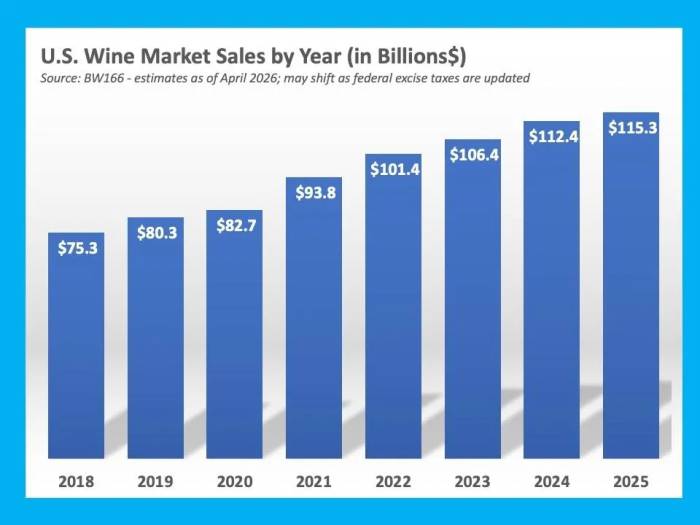
U.S. wine sales rose to $115.33 billion in 2025, even as the number of cases sold fell, according to a new report from BW166, a market research firm that uses government and tax data to track the industry.
The report, released last week, found that total calculated consumer spending on wine in the United States increased from $112.477 billion in 2024, a gain of 2.5%. Over the same period, volume declined from 370.7 million 9-liter cases to 361.8 million cases, a drop of 2.4%.
Jon Moramarco, managing partner of BW166 LLC, said in an online interview that the gap between rising revenue and falling volume reflects changes in what consumers are buying and where they are buying it. He said lower-priced wines have been losing ground while higher-priced wines have remained stable or grown, pushing up the average price per bottle.
“We are seeing declines in lower priced wines, while higher priced wines are stable or, in some cases, increasing,” Moramarco said. “This is driving a higher price per bottle sold, which is one factor impacting the $115 billion figure.”
Moramarco said another factor is the growth of private label and control label wines, which are made by wineries but sold under another company’s brand name. He said those wines have gained share with grocery stores, restaurants and large retailers including Costco, whose Kirkland brand has become a major seller.
“When we look at all of the data, we see an increase in private label and control label wines versus traditional brands,” he said. “Retailers in off-premise establishments often drive higher margins on these wines versus traditional brands.”
He added that much of that volume does not appear in syndicated scan data from firms such as NIQ or Circana, but it is reported to the federal government. BW166 relies on federal sources including the Bureau of Economic Analysis for consumer spending data and the Tax & Trade Bureau for alcohol tax information.
A third factor is the role of restaurants, bars and other on-premise outlets, where Moramarco said businesses are taking larger margins on beverage alcohol. That raises consumer spending but does not necessarily increase returns for producers and importers.
As a result, he said, revenue gains across the wine market are not being shared evenly. Many wineries and importers are under pressure from downsizing, sales and closures, and bankruptcies have also affected parts of the industry.
Inflation has added to those pressures by lifting prices across wine and other consumer goods.
Even with declining case volume in recent years, the United States remains the world’s largest wine market by both volume and revenue. It also remains a major destination for exporters; recent figures show that about 37% of wine consumed in the United States is imported.
“The good news is that consumers continue to spend slightly more year on year for wine, but it is still a tough and competitive market,” Moramarco said.
He pointed to demographic shifts as another challenge. Baby Boomers are aging and drinking less, while younger consumers have more choices than previous generations did, including THC-infused drinks, hard seltzers and other alcoholic alternatives. Health and wellness trends, along with wider use of GLP-1 medications, are also affecting alcohol consumption.
“The wine industry needs to appeal to consumers’ lifestyles and cuisine choices, and make wines at lower price points sexy again,” Moramarco said.
BW166’s latest report shows that U.S. wine sales revenue has risen for eight straight years, reaching its highest level yet in 2025. Moramarco said that growth can continue only if wineries adapt to changing consumer habits and compete more effectively with other drinks.
“The wine industry needs to take market share from other beverages,” he said. “They also need to appeal to more diverse consumers, appeal to consumers’ lifestyles and cuisine choices, and make wines at lower price points sexy again.”
He said many respected brands have become too expensive for younger consumers to drink regularly.
“The industry has been very effective at premiumizing over the past thirty years,” he said, “but when the average price of wine from Josh and La Marca, two well respected brands, is $3.00 for a five ounce glass at retail, compared with a bottle of Modelo for $1.40 or Tito’s and tonic for about $1.30 per drink at home, then wine may be beyond the means of some consumers.”

Founded in 2007, Vinetur® is a registered trademark of VGSC S.L. with a long history in the wine industry.
VGSC, S.L. with VAT number B70255591 is a spanish company legally registered in the Commercial Register of the city of Santiago de Compostela, with registration number: Bulletin 181, Reference 356049 in Volume 13, Page 107, Section 6, Sheet 45028, Entry 2.
Email: [email protected]
Headquarters and offices located in Vilagarcia de Arousa, Spain.