Adelaide Researchers Find Wine Process Can Cut Smoke Taint
The method preserved more fruit flavor than standard treatment in a pilot study of bushfire-affected wine
2026-04-20
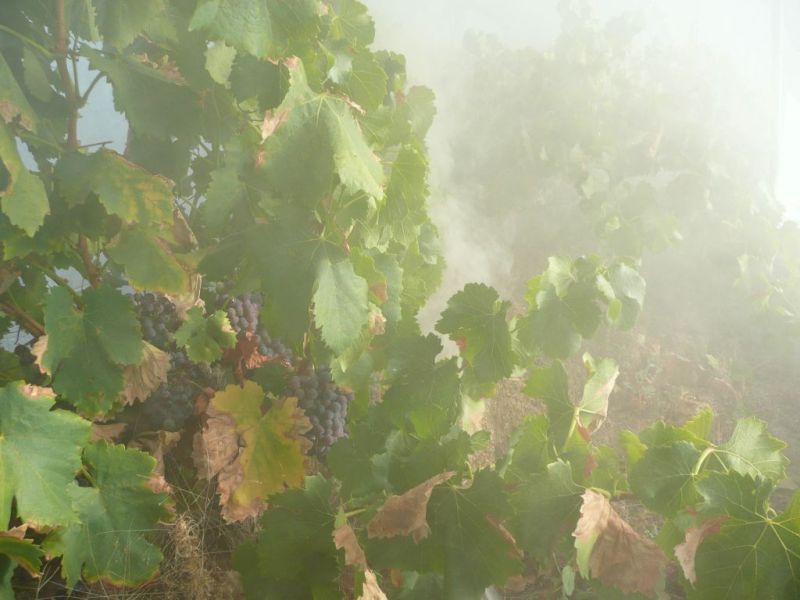
Researchers at Adelaide University say a dealcoholization process used in low- and no-alcohol wine production may also help winemakers reduce smoke taint, a growing problem for vineyards exposed to bushfire smoke.
The finding comes from work by Ysadora Mirabelli-Montan, a PhD student in the university’s School of Agriculture, Food and Wine, who tested spinning cone column distillation, or SCC, alongside activated carbon treatment. The university said the combined method produced a better result than activated carbon alone, preserving more of the wine’s fruit character while reducing the smoky notes that can make affected wines harder to sell.
Smoke taint has become a larger concern for wine regions in Australia and elsewhere as climate change increases the risk of bushfires. Smoke exposure can leave grapes with compounds that later show up in wine as ash-like, burnt or medicinal flavors. Those flavors can be difficult to remove without also stripping away desirable aromas.
Professor Kerry Wilkinson, who supervised the research, said the industry needs practical tools to manage climate-related damage to grapes and wine. She noted that global wine production was valued at US$333 billion in 2023 and is projected to reach US$379 billion by 2029, making quality protection an economic issue as well as an agricultural one.
SCC distillation works by using steam and centrifugal force to separate ethanol and aroma compounds into a condensate. What remains is a stripped wine made up mostly of water, acids, sugars, color and tannins. In the Adelaide study, most of the compounds linked to smoke taint stayed in that stripped portion, allowing researchers to apply activated carbon more selectively rather than treating the entire wine and risking further loss of aroma.
The treated stripped wine was then recombined with the condensate. According to the university, the result was improved fruit expression and less noticeable smoke character. Wilkinson said there were small but statistically significant changes in alcohol levels after treatment, but not enough to affect how the wines were perceived by tasters.
The trial also caused a sharp drop in sulfur dioxide, a common stabilizer used in winemaking. The university said that issue could be corrected after treatment.
The experiment was conducted on about 100 liters of wine using a pilot-scale SCC system. Wilkinson said larger commercial systems already used in industry could handle much bigger volumes, which means the approach could be tested further under real production conditions if wineries choose to adopt it.

Founded in 2007, Vinetur® is a registered trademark of VGSC S.L. with a long history in the wine industry.
VGSC, S.L. with VAT number B70255591 is a spanish company legally registered in the Commercial Register of the city of Santiago de Compostela, with registration number: Bulletin 181, Reference 356049 in Volume 13, Page 107, Section 6, Sheet 45028, Entry 2.
Email: [email protected]
Headquarters and offices located in Vilagarcia de Arousa, Spain.