Nals Margreid Unveils a Winery Designed to Put Winemaking on Display
The South Tyrol producer says its gravity-flow complex links production, hospitality and landscape to make cellar work visible to visitors.
2026-06-11
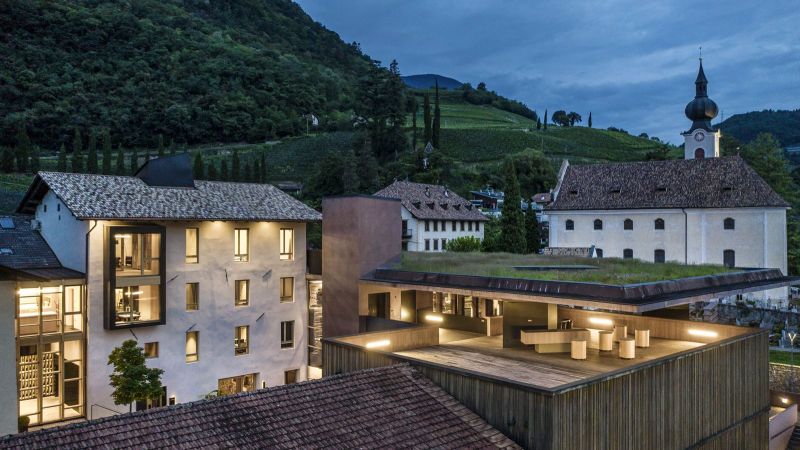
Nals Margreid, a winery in South Tyrol, is presenting its production site as part of its identity, highlighting a design that links winemaking, hospitality and the surrounding landscape in one place.
The winery, in Nalles near Bolzano, said Thursday that its complex was conceived to make the path from grape reception to aging visible to visitors while improving the flow of work for cellar staff. The project was designed by architect Markus Scherer and developed in stages from 2011 to 2020 after an initiative launched in 2007 to bring the company’s operations together at a single site.
At the center of the plan is a gravity-flow vinification system, which uses changes in elevation to move grapes and wine through production with less mechanical handling. That choice shaped the building itself. The winery said the layout follows the sequence of production, with a vinification tower serving as the technical core and a central courtyard, known as the Weinhof, functioning as both a work area and a space for visitors.
The company is also emphasizing transparency as a defining feature of the site. From the entrance, visitors can see into production rooms, barrel areas and aging spaces through glazed openings and interior sightlines. The aim is to make daily cellar work visible rather than hidden behind closed walls, and to connect wine tourism more directly with production.
That approach reflects a broader trend in European wine regions where wineries are increasingly designed not only as industrial facilities but also as public-facing destinations. In South Tyrol, where vineyards, villages and mountain landscapes are closely tied to tourism, architecture has become part of how producers present their wines and local identity.
Nals Margreid said its building volumes were designed to follow the contours of the land. The materials were chosen to reflect the area between Bolzano and Merano, including concrete pigmented with locally sourced porphyry aggregate, along with wood and glass. The winery said those choices were intended to reduce visual contrast with the surrounding environment and keep the structure tied to local building traditions.
The project also included the restoration of Ansitz von Campi, a historic farmhouse on the property. According to the winery, the building was incorporated into the larger complex without changing its original character. It now forms part of an ensemble that includes spaces for tastings, hospitality and wine sales alongside production functions.
The company described that restoration as an effort to preserve continuity between the site’s rural past and its current role as a modern winery. In practical terms, it means that visitors move through a property where older architecture and newer cellar spaces are presented as parts of one story rather than separate elements.
The winery’s architecture has drawn recognition before. In 2012, the project was featured at the Venice Biennale in connection with The Wine Cathedrals international competition, where it received recognition in the interior design category.
For Nals Margreid, the message is clear: the building is not meant to serve only as infrastructure for making wine. It is also intended to explain how the winery works, where it belongs and how it wants visitors to understand South Tyrol through wine, place and design.
